

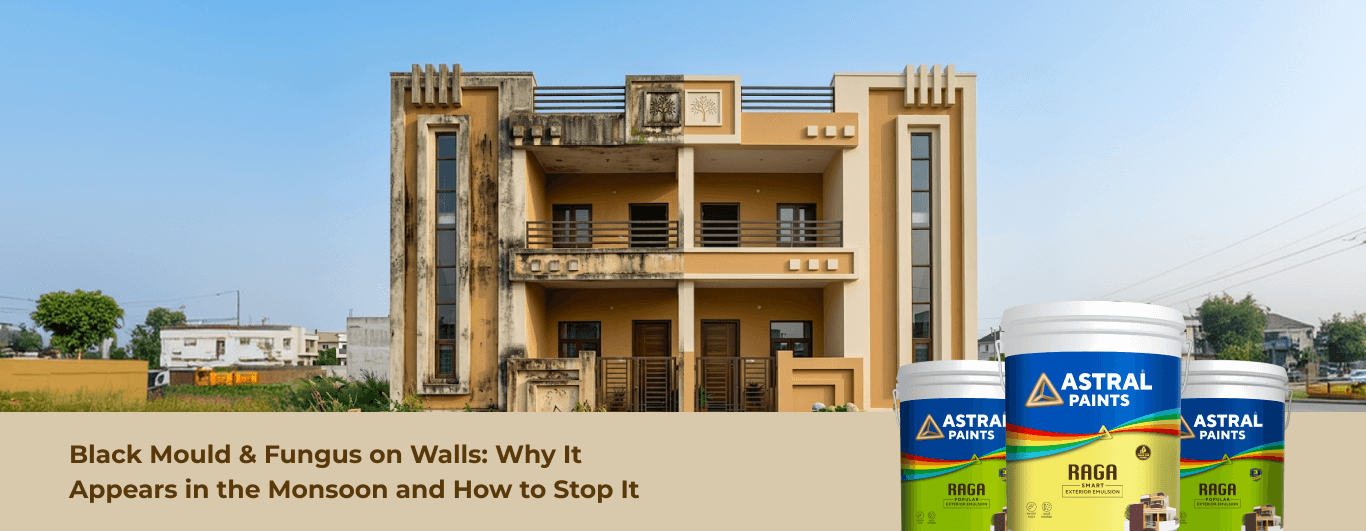
Black or green patches creeping across a wall, a musty smell in the room, a stain that keeps coming back however hard you scrub. That is mould, a fungus that grows wherever a surface stays damp and the air sits still. It is at its worst in the monsoon, when humidity is high and windows stay shut. And it is worth taking seriously, because mould is more than a stain. Its spores can aggravate allergies and breathing problems, especially for children and older family members. This guide explains why mould appears on walls, how to remove it safely, and how to stop it coming back. As with most wall problems, the real fix begins with the moisture.
Key takeaways
- Mould is a fungus that grows on damp walls. Its spores are always in the air and only need moisture to take hold.
- It thrives in the monsoon: in bathrooms and kitchens, in corners and behind furniture, and on cold outside walls.
- It is a health issue in its own right, well beyond the stain you can see. Spores can trigger allergies and asthma, especially in children and the elderly.
- Cleaning alone will not keep it away. You have to fix the damp and improve the airflow.
- Good ventilation and an anti-fungal finish are the best long-term defence.
What causes black mould on walls?
Mould spores drift through the air all the time, in every home. They only become a problem when they land somewhere damp enough to grow. Give them moisture, a little warmth and still air, and they can take hold within a day or two. Take any one of those away, and they cannot.

Mould needs moisture, warmth and still air together. Remove one and it cannot grow.
The moisture usually comes from condensation, a leak, penetrating or rising damp, or plain high humidity. That is why mould favours the cold, shaded outside walls where condensation forms, the corners and the patches behind furniture where air barely moves, and the steam-filled bathrooms and kitchens. During the monsoon, warm damp air and closed-up rooms give it near-perfect conditions, and a wall can go from clean to spotted in a couple of days.
Is black mould bad for your health?
Yes, and this is the reason to act quickly rather than live with it. The NHS notes that people living with damp and mould are more likely to have respiratory infections, allergies or asthma. Even for healthy adults, breathing in spores can bring on coughing, a runny nose or skin irritation if it goes on. The risk is higher for children, older people, and anyone with sensitive airways or an existing breathing condition. A stain you can scrub off; the air quality is the part that really matters.
How do I remove mould from walls safely?
Do it in this order, and mind your own safety while you work.
- Fix the moisture source first. A leak, condensation or a damp wall is feeding the mould. Clean without fixing that and it will simply return. Our guide to damp walls and seepage covers how to trace it.
- Protect yourself and open up the room. Wear gloves, eye protection and a mask (an FFP2 or FFP3), and open the windows so spores have somewhere to go.
- Do not dry brush it. Scrubbing dry mould flings spores into the air. Apply a mould-killing wash directly to the patch instead. For minor spots, white vinegar or hydrogen peroxide works; for heavier growth, use a dedicated mould remover.
- Let it dry completely. Once the mould is treated, dry the wall thoroughly before you go any further.
- Improve the airflow. Fit or use exhaust fans in bathrooms and kitchens, leave a gap behind furniture, and try to keep indoor humidity below roughly sixty per cent.
- Repaint with a protective finish. Prime the surface, then use a washable, anti-bacterial emulsion such as Astral Esteema Premium Sheen, which is easy to wipe clean and helps keep walls hygienic. On damp-prone walls, treat first with Astral Damp Safe outside or Dry Wall inside.
How do I stop mould coming back?
- Ventilate, ventilate, ventilate. Airflow is the single biggest factor. Open windows, run extractor fans, and do not let damp air sit.
- Fix leaks and waterproof damp walls. Deal with the water before the monsoon, not once the mould is back.
- Keep humidity down. Avoid drying clothes indoors in a closed room, which pushes moisture into the air.
- Warm the cold spots and free up corners. Even heating and a little space behind furniture stop the cold, still pockets where mould starts.
And resist the urge to simply paint over it. Fresh paint over live mould lets the growth push back through, and the trapped moisture lifts the coat. Kill it, dry the wall, then protect it with an anti-fungal finish.
Frequently asked questions
Why does mould keep coming back after I clean it?
Because cleaning removes the growth, not the cause. If the wall is still damp from a leak, condensation or seepage, the mould has everything it needs to return. Fix the moisture and the airflow, and the cleaning finally sticks.
Is black mould dangerous?
It is a genuine health hazard. Its spores can worsen allergies, asthma and other breathing problems, and the risk is higher for children, the elderly and anyone with sensitive airways. That is why it is worth removing promptly rather than living with it.
Does anti-fungal paint stop mould?
A mould-resistant or anti-bacterial finish helps a great deal, and makes walls easier to keep clean. But it works as part of the fix, not instead of it. You still need to clear the existing mould and deal with the damp first, or the growth pushes through.
Why is mould so much worse in the monsoon?
High humidity, damp walls and closed-up rooms come together during the rains. Those are ideal conditions for mould, which can begin to grow within a day or two, so a wall can spot over quickly.
What is the difference between mould and efflorescence?
Mould is a black or green, living fungus that grows on damp surfaces and is a health concern. Efflorescence is a dry, white or grey, crystalline salt drawn out of the masonry. Both point to damp, but they are cleaned and treated differently.
| Fighting mould or damp? Astral’s washable, anti-bacterial Esteema Premium Sheen keeps walls easy to clean, and the waterproofing range, Damp Safe and Dry Wall, tackles the moisture behind the growth. Explore the range, find your nearest Astral Paints dealer, or call our helpline on 1800 309 9393. |