

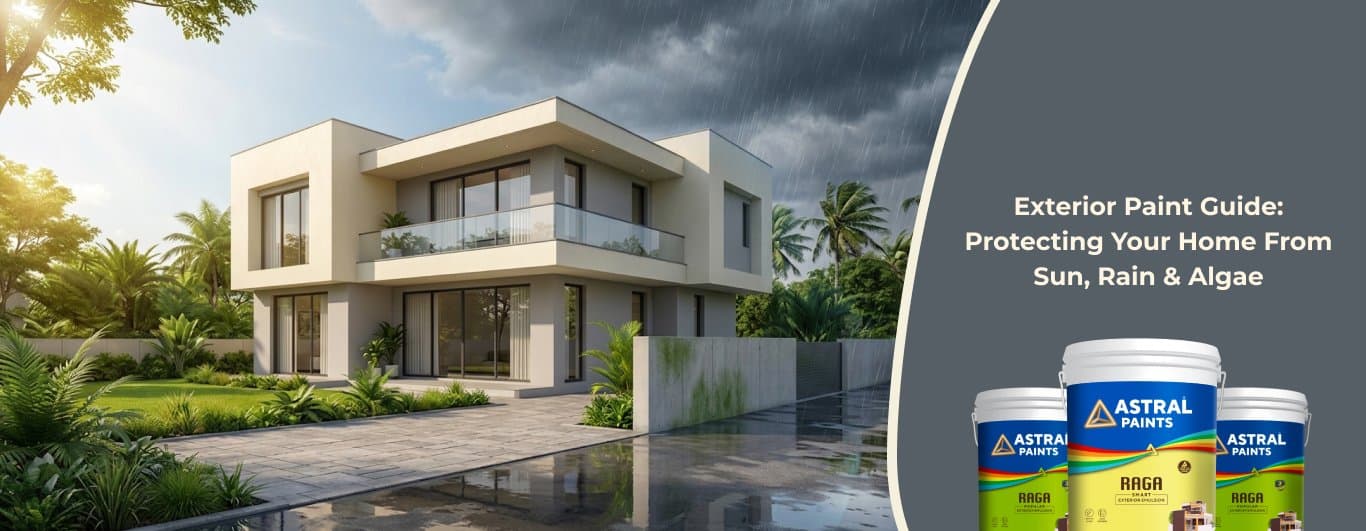
Exterior Paint Guide: Protecting Your Home from Sun, Rain & Algae
The outside of your home does the hardest job in the house. It takes the full force of the sun, the monsoon, the heat and the grime, day after day, while the inside stays sheltered. That is why exterior paint is a different animal from the paint on your living-room walls it is built less for looks alone and more to protect. Get it right and your walls shrug off the weather for years; get it wrong and they fade, flake and grow patches of green before the next monsoon is out.
This guide walks through what makes exterior paint different, what your walls are actually up against, how to pick the right one from our range, and how to get it on the wall so it lasts. It is written for the homeowner repainting a facade, with notes for the builders and contractors specifying paint across a whole project.
What makes exterior paint different
Interior and exterior paints come from the same emulsion family, but they live very different lives. An exterior paint leans on tougher, mostly acrylic binders and a set of protective additives that an indoor paint simply does not need. It has to repel water, hold its colour under harsh UV, flex with a wall that expands and contracts in the heat, and fight off the algae and dust that thrive in our climate. In short, an interior paint beautifies; an exterior paint defends and that is also what a good weatherproof paint is really about.
What your exterior walls are up against
Before you choose a paint, it helps to know the enemy. Out in the open, a wall faces five pressures more or less constantly.
- Sun and UV bleach the colour out of a lesser paint and break the film down until it chalks under your fingers.
- Monsoon rain drives water into porous walls, and where the paint cannot keep it out you get peeling, blistering and damp.
- Heat and humidity make walls expand and contract, opening hairline cracks that a rigid paint cannot bridge.
- Algae and fungus love warm, damp surfaces, leaving the green and black streaks you see on shaded walls.
- Dust and pollution settle on the surface and dull a finish that cannot shed them.
Choosing the right exterior paint
A good exterior paint answers all five of those pressures at once. When you are comparing options, look for genuine weather and UV resistance, water repellency, anti-algal and anti-dust properties, the flexibility to bridge small cracks, and a finish you can wash down. Here is how our exterior range lines up against those needs.
| Product | Tier | Best for & key features (manufacturer-stated) |
|---|---|---|
| Extura Plus Luxury | Luxury | Pure acrylic co-polymer; outstanding weather protection; anti-algal, anti-dust; crack-bridging; premium sheen and high washability — our toughest exterior finish |
| Extura Premium | Premium | Modified acrylic co-polymers; long-term durability; high washability and dust-proof properties for everyday facades |
| Raga Popular / Raga Smart | Value | A sensible step down for dry to moderately humid climates; good colour retention and algae resistance for everyday boundary and value jobs |
Match the paint to your climate
India is not one climate but many, and the right choice shifts with where you live. Coastal and high-rainfall regions, where salt air and damp drive algae, ask for the toughest, most water-repellent finish — Extura Plus territory. Hot, dusty plains reward a dust-shedding, washable film that keeps walls looking clean between cleans. Drier inland areas can do nicely on a value finish like Raga. And if your facade sits in heavy shade or under trees, lean towards the strongest anti-algal protection you can find, whatever the rainfall.
Getting it on the wall so it lasts
Even the best exterior paint is only as good as the surface beneath it. A little care here is what turns a fresh coat into years of protection.
- Clean and repair first. Wash off dust, dirt and any algae, scrape back loose old paint, and fill cracks so water has nowhere to sit.
- Treat damp at the source. If a wall stays wet or shows salt patches, sort the waterproofing before you paint — paint alone will not hold back water.
- Prime the surface. A suitable exterior primer seals porous masonry and gives the topcoat a sound, even base to grip.
- Apply two coats in the right weather. Two coats give uniform cover; paint when it is dry and mild, and avoid applying just before rain so each coat can dry properly.
Frequently asked questions
Can I use interior paint on outside walls?
No. Interior paint is not built for UV, rain or algae and will fade and peel outdoors within a season. Always use a paint made for exterior surfaces.
Which exterior paint is best for high-rainfall or humid areas?
Choose a tougher, pure-acrylic finish with strong anti-algal and water-repellent properties — our Extura Plus Luxury for the harshest conditions, with Extura Premium a step below. On damp-prone walls, pair it with proper waterproofing first.
How many coats does an exterior wall need?
Two coats over a primed surface is the standard for even colour and full protection. Deep shades or rough walls can occasionally need a third.
When is the best time to paint exterior walls?
In dry, mild weather — ideally before the monsoon — so each coat dries and cures properly. Avoid painting in heavy humidity, harsh direct sun, or just before rain.
Does exterior paint stop dampness on its own?
It resists rain and helps keep walls dry, but it is not a cure for an active leak or rising damp. For those, treat the source with a waterproofing product first, then paint over it.
The trust of Astral, now in paints
Astral Paints is part of Astral Limited — the group behind Astral Pipes, Adhesives, Bathware and construction chemicals. The same build-quality habit goes into every tin of our exterior range, backed by a 1,400-plus shade palette, a growing dealer network and technical support on the ground to help you protect a facade properly, whether it is one home or a hundred.
| Painting your exterior? Explore our exterior range and 1,400+ shades, find your nearest dealer for advice, or call our helpline on 1800 309 9393. Building professionals can also partner with us — ask about becoming an Astral Paints dealer. |