

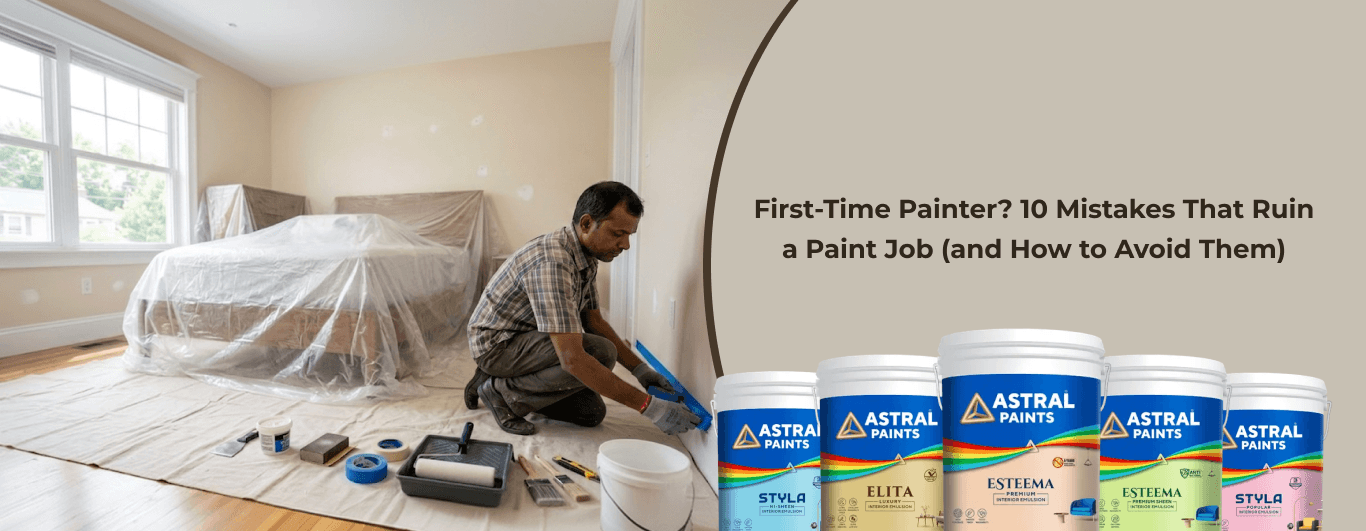
Painting a room for the first time looks simple enough. Open the tin, load the roller, cover the wall. And honestly, the painting part is the easy bit. Most first-timer mistakes happen around the paint, in the prep, the primer and the patience between coats. Get those wrong and even lovely paint can peel, streak or look patchy within months. Here are the ten mistakes that catch people out most often, and how to sidestep every one, so your first paint job looks like a professional did it.
Key takeaways
- Most painting mistakes happen in the preparation, not the painting itself.
- Clean, dry, well-repaired walls and a coat of primer prevent the majority of problems.
- Two coats, with proper drying time between them, are the difference between patchy and even.
- Painting over damp, cracks or a dirty wall is the quickest route to an early repaint.
- A little planning on quantity, weather and tools saves a lot of frustration later.
The 10 most common painting mistakes, and how to avoid them
None of these is complicated. Avoiding them is most of what separates a professional-looking wall from a patchy one.
- Skipping the prep. This is the big one. A finish is only as good as the wall under it, so clean, repair and sand before a drop of paint goes on. Ten minutes with a scraper and sandpaper now can save you repainting the whole wall in a year.
- Painting over a dirty or greasy wall. Dust, grease and cobwebs stop paint gripping. Wipe the wall down and let it dry so the new coat can actually bond.
- Ignoring cracks and uneven patches. Bumps and cracks show straight through fresh paint, and side lighting makes every one of them obvious. Fill cracks with a crack filler and skim uneven areas with wall putty, then sand smooth.
- Skipping primer. Primer seals the surface and helps the paint hold, especially on bare patches and fresh putty. Skip it and you often get patchy colour and early peeling. Think of it as the quiet layer that makes everything above it last longer.
- Painting over damp walls. Moisture behind the paint pushes it off from the back. Find and fix the damp first, treat it, and let the wall dry fully before you start.
- Not stirring the paint, or over-thinning it. Unstirred paint gives uneven colour, and too much water leaves it thin and streaky. Stir well, and thin only as much as the tin advises.
- Rushing between coats. A second coat over a first that is not dry drags and wrinkles the finish. Give each coat the recoat time on the tin, and longer in humid weather. Touch-dry is not the same as ready, so when in doubt, wait a little longer.
- Settling for a single coat. One coat rarely covers evenly. Two coats are the standard for a rich, uniform finish, and deep colours sometimes need a third.
- Painting in the wrong conditions. High humidity, a damp monsoon day or harsh direct sun all stop paint drying properly, which leads to streaks, slow curing and a soft finish that marks easily. Pick a mild, dry stretch, and keep the room ventilated so coats set as they should.
- Using poor tools and guessing quantities. Cheap brushes shed, and running out of paint mid-wall leaves a visible join. Use decent rollers and brushes, and work out how much paint you need before you begin.

Most of a good paint job is decided before the topcoat goes on.
How do I get a professional-looking finish?
The secret is not a special technique. It is doing the unglamorous steps well. Clean and repair the wall, putty it level, prime the patches, then lay on two coats with proper drying time in between, in mild and dry weather. Plan your paint quantity so you never run dry halfway along a wall. Do that, and the finish looks after itself. It is slower than diving straight in with a roller, but it is the difference between a wall you are proud of and one you quietly repaint next year.
Frequently asked questions
Do I really need primer as a first-timer?
On bare walls, fresh putty or patchy repairs, yes. Primer seals the surface and helps the topcoat grip evenly, which is exactly the safety net a first-timer wants. A sound, previously painted wall in good condition can sometimes go without.
How many coats of paint should I use?
Two coats over primer is the standard for an even, lasting finish. Deep or dark shades, and patchy old walls, can need a third. Let each coat dry for the time on the tin before the next.
How much paint will I need?
It depends on the wall area, the number of coats and the paint’s coverage. Measure the walls and work it out before you buy, so you have enough to finish each wall in one go and avoid visible joins.
Can I paint over old paint without prep?
Only if the old paint is sound, clean and dry. Even then, a wash and a light sand help the new coat stick. Flaking, glossy or dirty surfaces need proper preparation first.
What order should I paint a room in?
Work top to bottom: ceiling first, then the walls, then the trims and doors last. On each wall, cut in the edges with a brush, then fill the middle with a roller while the edges are still wet.
| New to painting? Astral’s putties, primers and washable emulsions, with advice from your nearest dealer, make a first paint job far easier to get right. Explore the range, find your nearest Astral Paints dealer, or call our helpline on 1800 309 9393. |