

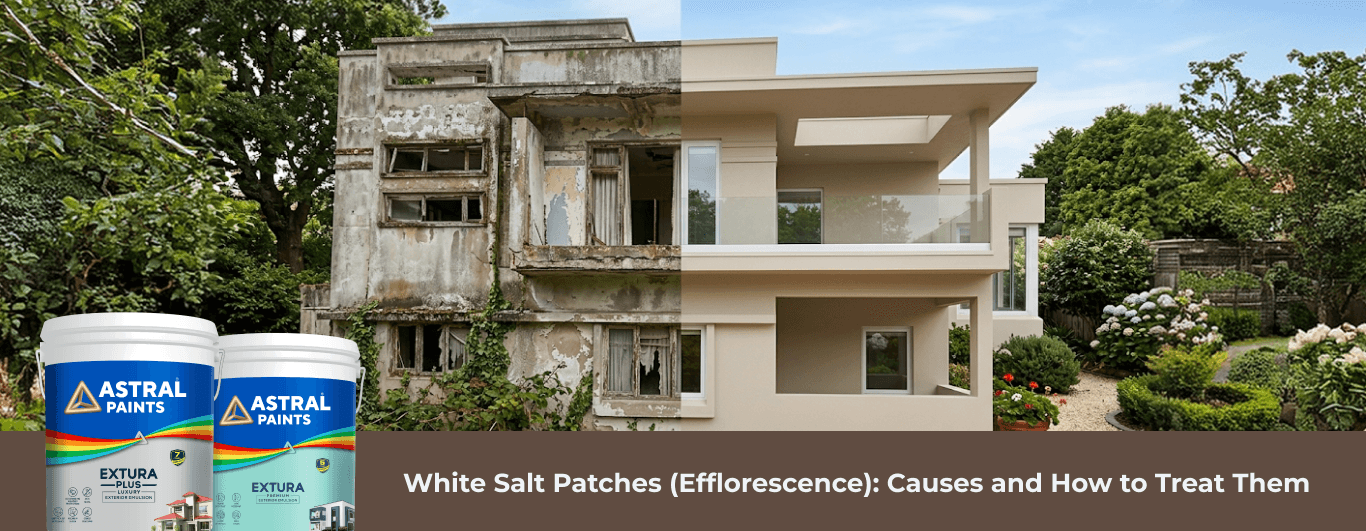
You have probably seen it: a chalky, white, powdery bloom spreading across a brick or plastered wall, often low down or on an outside face. That is efflorescence. The white patches are salt, drawn out of the wall’s own materials by moisture and left behind when the water dries. Touch it and it powders off on your fingers. It is harmless in itself, but it is trying to tell you something: water is moving through that wall. This guide explains what causes the white patches on your wall, how to remove them properly, and how to keep them from coming back. The short version is that you have to deal with the moisture behind them. Wiping the salt away on its own only hides the problem.
Key takeaways
- The white, powdery patches are efflorescence: salt from the wall’s own materials, left behind as moisture evaporates.
- It is harmless to touch, but it is a clear sign of a moisture problem that needs fixing.
- Three things cause it: soluble salts in the wall, moisture, and a path to the surface.
- Brush it off while it is dry. Wetting it first only drives the salt back into the wall.
- If it keeps returning, water is still getting in. Treat the source, let the wall dry, then repaint.
What is efflorescence, and what causes it?
Efflorescence is a white or greyish, powdery deposit that forms on brick, concrete, plaster and masonry. Building materials like cement, sand and brick contain natural, water-soluble salts. When moisture moves through the wall, it dissolves those salts and carries them to the surface. The water then evaporates into the air and leaves the salt behind as a crystalline bloom.
The Masonry Institute of America describes three conditions that must all be present for it to happen: soluble salts in the wall, enough moisture to dissolve them, and a path for that salty water to reach the surface and evaporate. Remove any one of the three and the white patches stop.

Efflorescence forms when moisture carries the wall’s natural salts to the surface and then evaporates.
You will most often see it on freshly plastered walls that are still curing, on exterior walls after heavy rain, in bathrooms and basements, and anywhere damp lingers. On a brand-new wall it often appears once, as the initial construction moisture dries out, and then fades. If it keeps coming back, though, water is finding its way in from somewhere, and that source is the real problem to solve.
Is efflorescence a problem, or just ugly?
Mostly it is a cosmetic nuisance. The salt itself will not harm you, and a light bloom often brushes away easily. The catch is what it signals. Efflorescence only appears where a wall has been wet, so it is a reliable early warning of a moisture issue you would want to catch. Left unchecked, that moisture can lift and peel your paint, and in some cases the salts crystallise just under the surface and cause the masonry to flake, a problem known as spalling. So the sensible response is to treat the damp, and not stop at the stain.
How do I remove efflorescence from a wall?
Removal is straightforward. Making it stay gone depends on the moisture step.
- Keep it dry and brush it off. Use a stiff, dry brush to sweep away the loose salt. Do not wet the wall first, because water simply re-dissolves the salt and carries it back inside.
- Tackle stubborn deposits. For patches that will not brush off, a mild solution of white vinegar diluted with water can help lift them. Test a small area first, rinse lightly, and let the wall dry. Take care on painted or decorative surfaces.
- Find and fix the moisture source. This is the step that actually matters. Rising damp, rain driving through an outer wall, or a hidden leak could be feeding the wall. Trace it and stop it. Our guide to damp walls and seepage walks through how.
- Let the wall dry fully. Give the wall real time to dry out. The salts cannot travel once the moisture is gone.
- Waterproof and repair. On damp-prone walls, treat the surface with Astral Dry Wall inside or Damp Safe outside, and use a moisture-resistant Waterproof Wall Putty to rebuild a sound, even base.
- Prime and repaint. Seal the surface with a primer, then finish with a suitable emulsion once everything is dry.
How do I stop efflorescence coming back?
- Fix the moisture at its source. This is the one that counts. No moisture, no efflorescence.
- Waterproof exteriors before the monsoon. Stop the rain getting into the wall in the first place.
- Let new plaster cure and dry. Give fresh masonry time to lose its construction moisture before you paint.
- Keep water away from the base of walls. Good drainage and no pooling water reduce the damp that feeds the salts.
And do not paint over a salted, damp wall in the hope of hiding it. The salt and moisture will push the fresh coat straight back off.
Frequently asked questions
Is efflorescence dangerous?
The salt itself is harmless to touch. What matters is what it points to: moisture in the wall. That damp can damage paint and masonry over time, and it can lead to mould, which is a health concern. So treat efflorescence as a useful warning rather than a threat in itself.
Why does my brand-new house have white patches?
New walls carry a lot of moisture from construction. As they dry, that moisture brings the natural salts to the surface, a one-off bloom often called new-building efflorescence. It usually eases as the wall dries. If it keeps returning, there is an ongoing moisture path to fix.
Can I just paint over efflorescence?
No. Paint over the salt and the moisture behind it and the coat will peel, taking the salt with it. Brush off the deposits, fix the damp, let the wall dry, and only then prime and repaint.
Will efflorescence go away on its own?
Sometimes. If it was caused by one-off construction moisture, it can weather away as the wall dries. If water keeps entering the wall, it will keep returning until you deal with the source.
What is the difference between efflorescence and mould?
Efflorescence is a dry, white or grey, crystalline salt drawn out of the masonry. Mould is a black or green, living fungus that grows on damp surfaces and is a health concern. Both are signs of damp, but they are treated differently.
| Battling white patches or damp? Astral’s waterproofing range, Dry Wall and Damp Safe, along with moisture-resistant putties, tackles the moisture that causes efflorescence. Explore the range, find your nearest Astral Paints dealer, or call our helpline on 1800 309 9393. |