

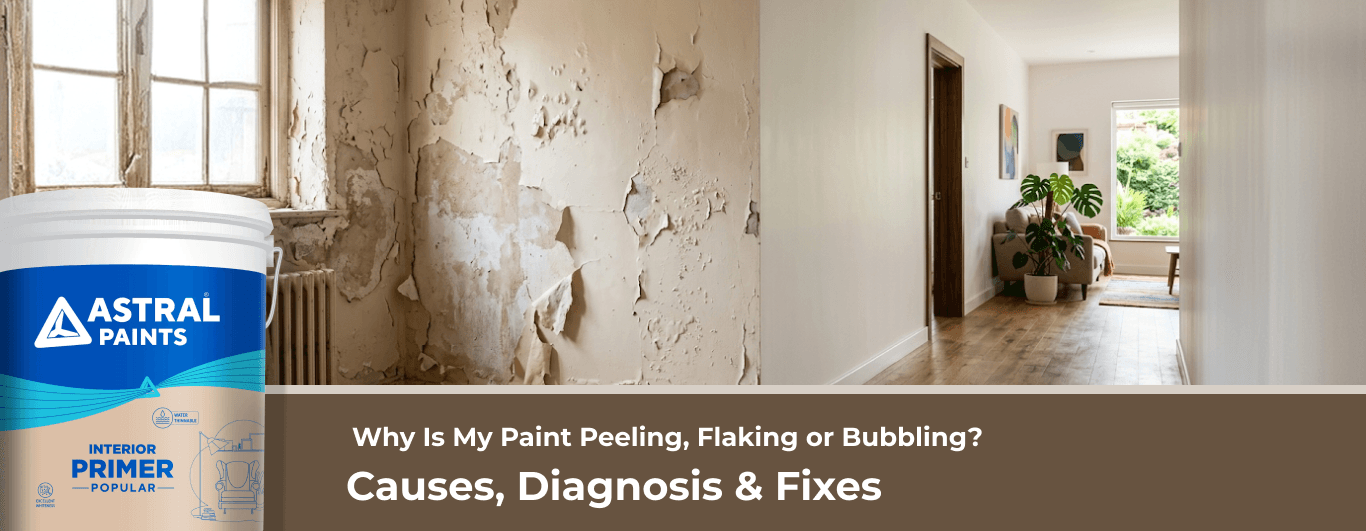
If the paint on your wall is peeling away, breaking into flakes, or rising into little bubbles, it is telling you one thing. It has lost its grip on the surface underneath. Nine times out of ten the reason is moisture, poor surface preparation, or a missing coat of primer. Each of these signs points to a slightly different cause, and once you know what you are looking at, the fix is usually simple. This guide explains what peeling, flaking and bubbling actually mean, how to trace the real cause on your own wall, and how to repair it so it does not come straight back.
Key takeaways
- Peeling, flaking and bubbling are all signs of a weak bond between the paint and the wall.
- Moisture is the most common cause, followed by poor prep and a skipped primer.
- Where the damage shows up (a damp bathroom, a sun-baked wall, a patch of white salt) usually tells you why.
- A lasting fix means treating the cause first, rather than painting over the damage.
- Good prep and the right primer stop most of these problems coming back.
What’s the difference between peeling, flaking and bubbling?
These words often get used to mean the same thing, but each describes a slightly different failure, and each hints at a different cause.
Peeling is when the paint lifts and comes away from the wall in strips or flakes. It is an adhesion problem, which simply means the paint never bonded properly to what was beneath it. Flaking is what peeling turns into over time. The film goes brittle and drops off in small chips, most often on older or chalky walls.
Bubbling (also called blistering) is different. Here the paint rises into raised pockets, because air, heat or moisture got trapped under the film. And if you spot a chalky white powder around the damage, that is efflorescence: salts pushed out of the masonry by damp. It is a clear sign the wall itself needs attention, not the paint alone.

Each sign of paint failure points to a different cause, and often to a different fix.
What causes paint to peel, flake or bubble?
Most cases come down to a handful of culprits.
- Moisture and damp. The biggest one by far. Water from a leak, rising damp or everyday humidity gets behind the paint and breaks its bond from the back. This is why bathrooms, kitchens and exterior walls suffer most.
- Poor surface preparation. Painting over a dirty, greasy, glossy or dusty wall gives the paint nothing to hold on to.
- No primer. Primer is the layer that helps paint grip and seals a thirsty surface. Skip it and the topcoat often lets go early.
- The wrong conditions. A damp wall, a rain-soaked exterior, or a surface baking in the afternoon sun all stop paint from drying and bonding as it should.
- Old or low-quality paint. Weak binders and worn, chalky coats lose their grip and flake with age.
How do I find the real cause on my wall?
Before you repair anything, spend two minutes working out why it happened. The clues are usually right there.
Look at where it is. Bubbling and peeling in a bathroom or kitchen almost always point to humidity and condensation. On an outside wall that acts up after the monsoon, suspect rain getting in. A patch of white, powdery salt means damp is pulling minerals out of the masonry.
Try the blister test. Gently lift a bubble or a peeling flake and look underneath. If you are down to bare plaster or wall, moisture is the likely cause. If you find sound primer or an older coat under it, the problem is more likely heat, or paint that dried too fast. That is common on a sunny wall, or when a coat went on too thick.
Check the other side. If a bubble sits on a wall shared with a bathroom, a kitchen or an outside face, the water may be coming from there. A musty smell or a spreading brown stain is another sign of a hidden leak.
How do I fix peeling, flaking or bubbling paint?
Here is the sequence that gives a lasting result, rather than a quick patch that fails again.
- Find and fix the source first. If moisture is behind it, sort that out before anything else: a leak, seepage or a damp wall. On damp-prone walls, a waterproofing treatment such as Astral Damp Safe outside or Dry Wall inside helps stop water getting back in. Paint on its own cannot hold water back.
- Remove the loose paint. Scrape off every flake and blister with a putty knife until you reach a firm, sound edge, then sand the edges smooth so the repair will not show.
- Clean and dry the wall. Wipe away dust, grease and any salt deposits, then let the surface dry completely. Painting over damp is how the whole cycle starts again.
- Repair and level the surface. Fill cracks and dents with Astral Crack Fill Paste, and use a wall putty such as Acrylic or Smooth Wall Putty to bring the patch level with the wall. Sand it smooth once dry.
- Prime the surface. A coat of primer seals the wall and gives the paint something to grip. Astral’s interior and exterior primers are made for exactly this, and they matter most on fresh putty or bare patches.
- Repaint with two coats. Finish with two coats of a good emulsion matched to the wall: an interior emulsion such as Elita or Esteema inside, or a weather-tough exterior such as Extura outside. Give each coat time to dry.
How do I stop it happening again?
Prevention is mostly about the basics, done properly.
- Deal with damp at the source. Fix leaks and waterproof damp-prone walls before you paint, not after.
- Never skip prep and primer. Clean, dry, level walls and a proper primer prevent most adhesion failures.
- Pick the right conditions. Avoid painting on wet walls, in heavy humidity, or in harsh direct sun.
- Use paint suited to the surface. A washable emulsion indoors, a weatherproof one outside, and enamel on metal and wood.
Get these right and peeling, flaking and bubbling become rare visitors rather than a yearly headache.
Frequently asked questions
Is peeling paint always a sign of damp?
Not always, but damp is the most common cause. Peeling can also come from poor prep, a missing primer, or paint that never bonded to a glossy or dusty surface. The blister test and the location usually tell you which.
Can I just paint over peeling or flaking paint?
No. Fresh paint over loose, flaking paint will lift along with it. Scrape back to a sound surface, repair, prime and then repaint for a fix that lasts.
Why does paint bubble in my bathroom or kitchen?
Those rooms get the most steam and condensation. That moisture gets trapped under the paint and lifts it into blisters. Better ventilation, a moisture-resistant finish and proper prep all help.
Does primer really stop paint from peeling?
It helps a great deal. Primer seals the surface and gives the topcoat something to grip, which is why skipping it is one of the most common reasons paint fails early.
There’s white powder where the paint is flaking. What is it?
That is efflorescence: salts carried to the surface by moisture in the masonry. Brush it off, but treat it as a sign of damp that needs fixing before you repaint, or it will keep coming back.
| Dealing with peeling or damp walls? Astral’s primers, wall putties and waterproofing range are made to fix the cause and keep it fixed. Explore the range, find your nearest Astral Paints dealer for advice, or call our helpline on 1800 309 9393. |